 ×
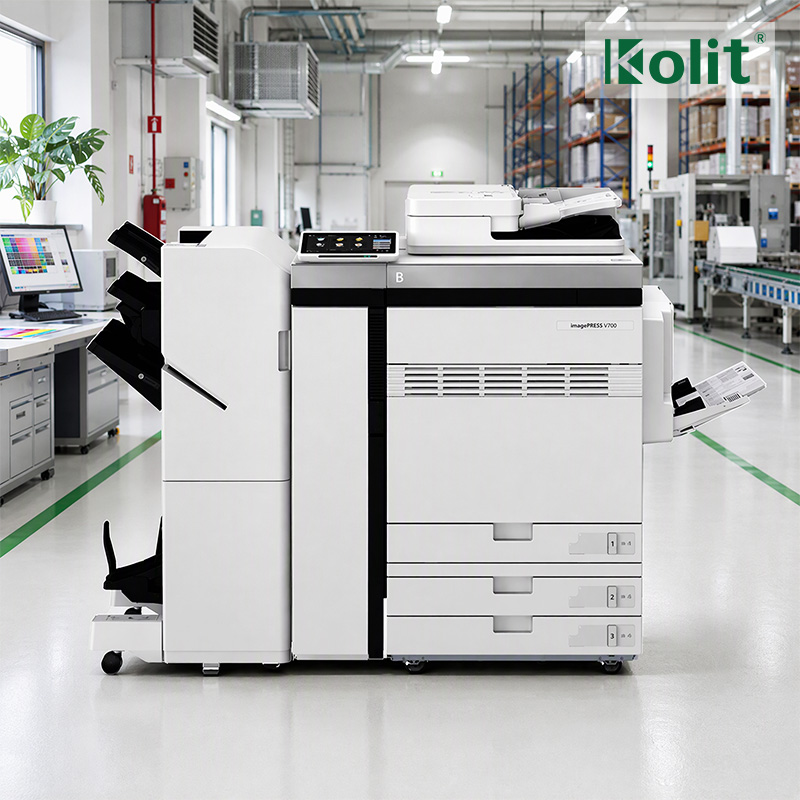
Canon imagePRESS V900 Series:
70–90 ppm A3 light-to-mid production press.
350 gsm, 762 mm auto duplex,
1.3 m simplex banner,
standard ILS automation, PRISMAsync or Fiery.


Canon imagePRESS V900 Series / imagePRESS V700 V800 V900 / light-to-mid volume production press / 90 ppm production press / 350 gsm digital press / 762 mm duplex banner press / PRISMAsync ILS / compact production press
The imagePRESS V900 Series occupies a specific position in the production print lineup: it is Canon's compact entry into the light-to-mid volume production class, engineered for print service providers and in-plants that need true production throughput and media flexibility without the floor space or capital step of a heavier mid-range platform. Three models — V900, V800, and V700 — deliver rated A4 speeds of 90 ppm, 80 ppm, and 70 ppm respectively, share the same 2400 × 2400 dpi R-VCSEL imaging engine, and support media from 52 gsm plain paper to 350 gsm cover stock. Monthly duty reaches up to 500,000 A4 pages, a profile that places the series squarely in the light-to-mid production bracket rather than the high-volume floor.
The operational pitch is not “fastest in class.” It is the combination of a compact chassis, a 350 gsm media ceiling, 762 mm auto duplex, 1.3 m simplex banner capability, and standard inline spectrophotometer automation — capabilities that in competing configurations often require a physically larger or higher-tier machine. For a print operation weighing a Ricoh Pro C7200 or C7500 against this series, the V900 Series makes its case on application coverage per square metre of floor space, not on a single speed headline.
imagePRESS V900 — 90 ppm. The top of the series, for environments where the deadline profile leaves no room for queue accumulation: short-run commercial collateral, marketing collateral, and mixed-media job streams that need the press to hold pace with prepress and finishing.
imagePRESS V800 — 80 ppm. The mid configuration, for in-plants and commercial shops that need production-class output across the shift but do not run continuously at the top of the speed band.
imagePRESS V700 — 70 ppm. The entry point into the series, with the same 350 gsm ceiling, the same 762 mm duplex long-sheet handling, and the same controller and automation options as its faster siblings. For a provider stepping up from a light-production device — or comparing against a 65 ppm Ricoh Pro C5400S — the V700 keeps the application range intact while matching the lower end of the production speed band.
What does not change across the three models is the imaging platform or the media ceiling. Speed and duty rhythm shift; the upper bound of the job mix does not.
The V900 Series' most consequential differentiator is not a speed number — it is the degree to which colour management and registration setup have been automated. Inline Spectrophotometers (ILS) are standard on the series, handling engine linearisation, media calibration, ICC profile creation, and colour validation without requiring an operator to run and read separate charts. When paired with the PRISMAsync print server, colour calibration and profile creation can complete in minutes at the push of a button — a workflow asset for shops where operator skill levels vary across shifts.
The Duplex Colour Image Reader Unit extends automation to registration and density setup. Operators run printed adjustment charts through the ADF, and the press automatically corrects front-to-back registration (to within 0.8 mm), colour gradation, density, and secondary transfer voltage — including on textured stocks that traditionally demand manual adjustment. The practical effect is a shorter path from job file to sellable sheet, with less dependence on a highly skilled operator to hold quality across a mixed-media queue.
Where the Ricoh comparison becomes relevant: the Pro C7200 and C7500 class is built around high-volume reliability and a 40–470 gsm media range, but the automation emphasis sits differently. The V900 Series positions ILS and auto-registration as standard infrastructure for light-to-mid production, not as options reserved for a higher tier.
The series supports 52 gsm to 350 gsm across plain, coated, thick, embossed, synthetic, and envelope stocks. The long-sheet specification is the operational differentiator in this bracket: auto duplex up to 762 mm and simplex up to 1,300 mm, covering six-panel brochures, book dust jackets, multi-fold leaflets, and banner work that would otherwise be pushed to a wide-format device or an offline finishing step.
Feeding is supported by vacuum technology that adjusts suction force to paper weight, stabilising transport of thick stocks, alongside feed rollers and strengthened transport rollers tuned for thin, thick, and short paper. The Multi Drawer Paper Deck's Multi Sheet Detection diverts jam-prone sheets to a dedicated purge tray without stopping the press — a small automation detail that protects uptime on long runs.
The competitive context here is precise. The Ricoh Pro C5400S covers 65 ppm, 360 gsm duplex, and a 1,300 mm banner, but sits at the lower end of the speed band. The Pro C7200 moves to 85 ppm and 360 gsm with banner duplex, but in a heavier mid-production chassis. The V900 Series places 90 ppm, 350 gsm, 762 mm duplex, and 1.3 m simplex into a compact chassis — a configuration aimed at shops that need the long-sheet and heavy-stock range without stepping into a larger footprint or a higher capital bracket.
The series does not force a single digital front end. Two controller paths cover the operational profiles in this segment:
PRISMAsync — Canon's integrated production controller, built around an 8-hour Job Scheduler and a unified interface designed for operators moving from office equipment into production print. PRISMAremote Manager allows job upload, scheduling, and monitoring from a web-based platform, relevant for unattended or lightly staffed shifts. The ILS automation is natively orchestrated through PRISMAsync, which is the controller path where colour tasks complete with the least manual intervention.
EFI Fiery imagePRESS Server N500 / P400 — The N500 runs the Fiery NX Pro platform with FS500 Pro system software, 8 GB memory, and a 1 TB HDD plus 240 GB SSD. The P400 uses the E500 platform with 500 GB HDD. Both bring Fiery Command WorkStation, Fiery Impose/Compose, and FreeForm variable-data capability to the series, preserving colour tooling and operator familiarity for shops already anchored to the Fiery ecosystem.
The structural point for a buyer comparing against Ricoh: Fiery is available across this class from both vendors, so the DFE is rarely the deciding variable. The more consequential question is whether the press's native automation — ILS, auto-registration, purge-on-detect — reduces the labour required to hold colour and registration across a mixed queue, independent of which DFE sits in front of it.
The inline finishing chain reaches beyond stapling: collate, group, offset, corner and double stapling, saddle stitching, hole punching, folding (C-, Z-, half, double-parallel, accordion-Z), document insertion, and trimming. The Booklet Finisher AG1 supports body sheets from 52–220 gsm with cover sheets to 300 gsm, and third-party inline finishing extends the chain into wire binding and perfect binding configurations.
Combined with the media range and long-sheet capability, the configuration covers:
Commercial collateral: six-panel brochures, saddle-stitched booklets, multi-fold leaflets, and presentation materials.
Direct mail and premium promotional work: 350 gsm stocks, envelopes, embossed and synthetic media, and variable-data pieces.
Long-sheet applications: dust jackets, multi-fold signage, and banner work up to 1,300 mm simplex / 762 mm duplex.
Light book production: folded and stapled booklets, with inline trimming and booklet-making configured to the bind style.
Product Description
Copy Speed |
70-90 ppm (Black & White / Color same speed, A4 Portrait) |
First Copy Time |
6.5 sec (B&W), 7.3 sec (Color) |
Print Speed |
70-90 ppm (Black & White / Color same speed, A4 Portrait) |
Scan Speed |
B&W: Up to 270 opm (Letter, 300 dpi)
Color: Up to 270 opm (Letter, 300 dpi)
|
Print Resolution |
2,400 × 2,400 dpi (256 gradations, CV toner rendering) |
Power Supply |
220–240V, 50/60Hz, 13A × 2; Max power consumption: 3520W |
Paper Sizes |
• Standard Trays: SRA3, A3, A4, A5, A6, B4, B5, B6, 13" × 19.2", 12" × 18", 11" × 17",
Legal, Letter, Executive, Custom sizes (182 × 182 mm to 330.2 × 487.7 mm), Envelopes
• Bypass Tray: SRA3, A3, A4, A5, A6, B4, B5, B6, 13" × 26", 12" × 18", 11" × 17",
Legal, Letter, Executive, Custom sizes (100 × 148 mm to 330.2 × 660.4 mm), Envelopes
|
Paper Weight |
• Standard Trays: 52–320 g/m²
• Bypass Tray: 52–350 g/m²
|


The imagePRESS V700/V800/V900 is aimed at the print service provider or in-plant manager who has already surveyed the light-to-mid production band — including Ricoh's Pro C5400S, C7200, and C7500 — and is weighing where the application ceiling sits against floor space, operator skill requirements, and capital outlay. The series consolidates a 350 gsm media ceiling, 762 mm auto duplex, 1,300 mm simplex long sheet, standard ILS colour automation, and PRISMAsync/Fiery controller choice into a chassis Canon positions as the most compact in the imagePRESS V family. For the operation that needs production-grade colour and long-sheet capability without stepping into a heavier mid-range platform, this is the configuration where the job mix the shop actually runs meets the floor space and labour model it can actually sustain.
Request a sample print evaluation or a workflow consultation with your local Canon production print specialist.


 EN